Guides
Print Shop Equipment Checklist: Questions to Settle
Use this print shop equipment checklist to frame space, power, prepress, press, finishing, safety, chemical, and stock questions to settle before ordering.
What to take away
- Use this print shop equipment checklist in order. Room, power and material flow decide what fits; the machine decides what you can sell; finishing decides how fast it leaves.
- Do not buy press capacity you cannot finish. The folder and the cutter set the delivery date more often than the press does.
- Safety obligations are not optional. Identify applicable OSHA requirements, environmental permits and manufacturer instructions before ordering.
- Every machine needs a trained second operator before it is a business asset rather than a scheduling risk.
- Tick nothing from memory. A checklist you completed from recollection is a list of what you assumed.
Before any machine is ordered
These are the items that stop an installation dead if they are missed, and they are all cheap to check early.
Pre-order installation checks
- Measured route from door to machine
- Floor loading confirmed in writing
- Electrical phase and capacity confirmed
- Compressed air clean and dry
- Temperature and humidity control
- Space allowance from layout drawing
- Pallet drop and press access
An installation is stopped far more often by a doorway, a floor loading or a missing three-phase supply than by anything on the machine itself.
Prepress and the front of the shop
- Workstation capable of running the file formats customers actually send, with enough storage for archived jobs
- A calibrated monitor, and a written statement to customers about what a screen proof does and does not cover
- Proofing method decidedhard copy, contract proof from the press, or content-only screen view, and priced accordingly
- A preflight step that catches the common three: wrong color space, no bleed, and fonts that are not supplied or outlined
- Font and asset handling policy, because a customer's font licensing is not automatically yours to use
- File archive with a retention period you have actually decided rather than defaulted into
- Job ticket format that carries the specification, the approved proof reference and the quoted time
Press and output
- Process chosen against the quantity range you can see in the market, and the other end of that range covered by a trade partner
- Substrate range confirmedweights, coatings, textures and anything synthetic you intend to sell
- Consumable model understood in fullplates and chemistry, or a click charge and what it covers
- Minimum volume commitment in any service or click contract, checked against realistic first-year output
- Service coveragewho fixes it, how fast, and whether parts are held locally
- Two people trained on it before it becomes a delivery promise
Finishing, which is where jobs stall
- Cutter sized for the parent sheets you will run, not for the finished pieces
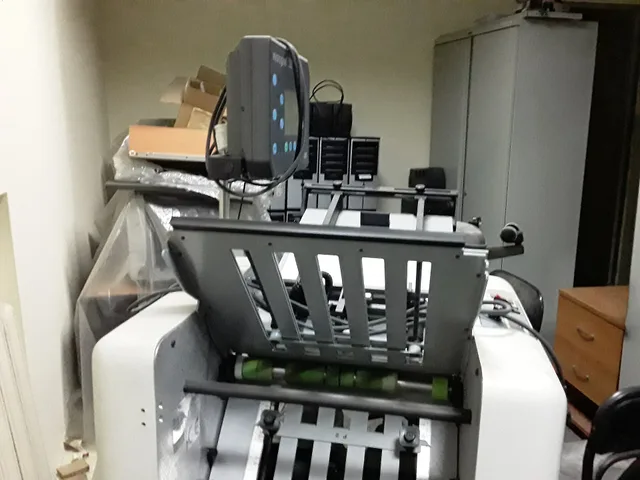
- Folding capability matched to the folds your intended work needs, including the ones customers ask for late
- Stitching, drilling, laminating and scoring assessed against the same demand, and each one costed as buy or send out
- Hand assembly space and a plan for who does it when three jobs land together
- Packing materials, scales and a shipping method that does not depend on one person
Finishing is the constraint that bites. A press can clear a job in an afternoon, then hand it to a single folder that needs two days. The production schedule shows none of that until the work is standing there.
How that plays out day to day is set out in how a job moves through the shop and where it waits.
Safety, chemicals and the building
Use this section to identify requirements before ordering, then confirm which ones apply to your equipment, process and location. The standards cited below are starting points; state and local permit requirements can vary.
Safety and chemical questions
- Machine guarding against manufacturer and OSHA
- Energy isolation procedure written and trained
- Chemical inventory with safety data sheets
- Solvent and ink storage meets fire authority
- Waste disposal route confirmed with state agency
- Ventilation and air permit put in writing
- PPE specified per task, not generic
- Machine guarding reviewed against 29 CFR 1910.212, General Requirements for All Machines, and the manufacturer's documentation
- Energy isolation procedure written for maintenance on each machine, with the people who will perform it trained; review 29 CFR 1910.147, The Control of Hazardous Energy (Lockout/Tagout)
- Chemical inventory with safety data sheets available to the people using them, and container labeling reviewed under 29 CFR 1910.1200, Hazard Communication
- Storage for solvents and inks checked against what your fire authority and state environmental agency require
- Disposal route for waste ink, solvent, rags and used chemistry confirmed with your state environmental agency; determine whether waste is hazardous under the Resource Conservation and Recovery Act (RCRA)
- If hazardous-waste generator identification is required, ask the state agency whether to submit EPA Form 8700-12, Notification of RCRA Subtitle C Activities (Site Identification Form), or a state equivalent
- Ask the state environmental agency whether your process and location require an air permit or coverage under a National Pollutant Discharge Elimination System (NPDES) industrial stormwater permit; applicability and filing routes vary
- Personal protective equipment specified per task rather than issued generically
- First aid, spill response and fire equipment appropriate to what is actually stored
OSHA's printing industry pages are the starting point for what applies to this trade. For machine guarding, review 29 CFR 1910.212, General Requirements for All Machines; for maintenance energy isolation, 29 CFR 1910.147, The Control of Hazardous Energy (Lockout/Tagout); and for chemical labels and safety data sheets, 29 CFR 1910.1200, Hazard Communication. Confirm which provisions apply to your equipment and operation.
OSHA's safety management guidance sets out program structure a small employer can build around those duties. For a broader map of licensing, permits and which body to contact, use who regulates which part as a companion to these equipment checks.
Stock, consumables and the first order
- House stocks chosen and a supplier relationship opened before the first customer job, not during it
- Minimum order quantities and lead times written down for each stock you intend to hold
- Storage that keeps paper flat, dry and conditioned to the room it will run in
- Reorder points set by lead time rather than by looking at the shelf
- A reconciliation habitparent sheets in against product out, per job
Terms, minimums and who you buy from are worked through in how paper and consumables are sourced. Size all of it against what you can actually sell, which is the job done in reading demand before committing capital, and read the machine decisions themselves beside what each press commits you to.
Common questions
What is the smallest kit that can take real work?
Small enough that it can be measured rather than described. A shop that can prepress a file, produce one process well, cut it, and pack it can trade. Everything else can be sent out until the volume justifies owning it.
Should finishing be bought at the same time as the press?
At least the cutter. A shop with a press and no cutter is a shop that cannot deliver a finished piece, and hiring the operation out on every job removes the margin the press was supposed to earn.
How do I know whether a machine needs a permit?
A permit depends on your process and location, not just the machine. Ask your state environmental agency whether the operation requires an air permit, NPDES industrial stormwater permit coverage, or hazardous-waste generator identification, and which filing route applies. Requirements and forms vary by state and operation.
Do I need a second operator from day one?
You need a plan for the day the first one is not there. That may be cross-training, an on-call arrangement, or a trade partner. What it cannot be is a hope.