Guides
OSHA and EPA compliance for small US print shops, explained plainly
Two federal agencies set the safety and environmental rules for a small US print shop. Here is what each one inspects and how to stay ready.
What to take away
- OSHA governs worker safety in the pressroom under 29 CFR 1910; the EPA governs air emissions, waste ink and solvent disposal under the Clean Air Act and RCRA.
- Hazard communication, machine guarding and lockout/tagout are the three standards a small shop is most likely to be cited under.
- Solvent use above your state's threshold can trigger an air permit; waste ink and cleanup rags may be hazardous waste until you determine otherwise.
- OSHA lists 22 State Plans that cover private-sector workers and seven that cover only state and local government workers. California runs a private-sector plan; New York's plan covers public employees only.
- On the waste side, the EPA sorts generators by monthly hazardous waste: 100 kilograms or less (very small), more than 100 but less than 1,000 kilograms (small), and 1,000 kilograms or more (large).
- A written calendar with monthly, quarterly and annual tasks keeps a shop ready for an inspection without a full-time safety officer.
What OSHA actually inspects in a pressroom
OSHA's General Industry standards live in 29 CFR 1910. The agency does not exempt shops by size, though the routine injury recordkeeping rule eases for firms with fewer than 11 employees.
OSHA Standards by Shop Area
Pressroom
- Hazard communication
- Yes
- Machine guarding
- Yes
- Lockout/tagout
- Yes
- Ventilation
- Yes
Bindery
- Hazard communication
- Yes
- Machine guarding
- Yes
- Lockout/tagout
- Yes
- Ventilation
- No
Prepress
- Hazard communication
- Yes
- Machine guarding
- No
- Lockout/tagout
- No
- Ventilation
- No
Pressroom, bindery and prepress each trigger different standards. The ones that produce citations in small shops are hazard communication, machine guarding, lockout/tagout and ventilation.
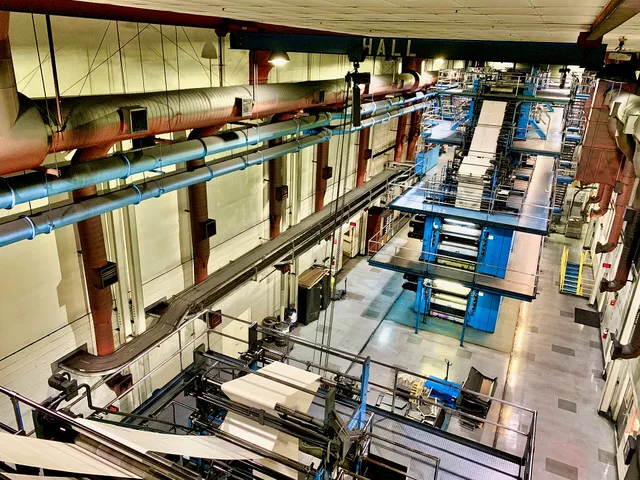
A print shop compliance checklist maps each standard to a room and a responsible role. Start in the pressroom, where solvents and moving parts sit closest together.
If ventilation alone cannot hold solvent vapor below the permissible exposure limit, you fall into OSHA's respiratory protection standard. That brings medical evaluations, fit testing and training.
PRINTING United Alliance and the former Printing Industries of America publish safety guides that translate the regulation into pressroom language. Inspectors recognize the practices even though the guides are not law.
Shops with more than 10 employees also need a written emergency action plan covering exit routes and a headcount after evacuation.
Ventilation, hazard communication and PPE in the pressroom
Ventilation
Permissible exposure limits come from 29 CFR 1910.1000. Solvent vapor, ink mist and paper dust all count against them.
Dilution ventilation can carry a small press running low-solvent inks. A solvent-based press usually needs local exhaust at the source: a hood over the ink fountain, a duct on the dryer.
Have a qualified industrial hygienist measure exposure before you assume the system works. The monitoring results become your baseline and your defense if an employee files a complaint.
Hazard communication
The Hazard Communication overview sets out the federal requirements for classifying and communicating chemical hazards. In practice a shop needs three things: a written program, a safety data sheet for every chemical on site, and a label on every container.
That covers ink, fountain solution, blanket wash, plate developer and the spray can on the bench. Keep the sheets reachable on every shift, not locked in the office.
Train on the specific chemicals each operator handles, including how to read a pictogram and what to do after a splash. Retrain when a new product arrives.
PPE
Nitrile gloves, eye protection and an apron are standard for anyone handling solvents. Respirators pull the whole respiratory protection program in with them, so most small shops reach for engineering controls first.
A print shop operations and workflow review shows where solvent use clusters and where substitution removes the exposure entirely.
Lockout/tagout and guarding on imprint and finishing equipment
Lockout/tagout
The rule is 1910.147, the control of hazardous energy. It applies whenever an employee services a machine that could start unexpectedly.
Machine Compliance Steps
- List every machine with moving parts or stored energy
- Write lockout/tagout procedure and issue machine lock
- Install or repair guards at points of operation
- Train authorized employees and document the training
- Inspect lockout/tagout procedures annually and keep records
In a small shop that means a written energy control procedure per machine, a lock and tag for each authorized employee, and an annual inspection of the procedures. Guillotine cutters, folders, stitchers, die cutters and any press with reachable moving parts during maintenance all fall under it.
Machine guarding
1910.212 requires guards at points of operation, rotating parts and flying-chip zones. A guillotine needs a two-hand control or a guard that keeps hands out of the cut zone. A folder needs covers over nip points and belts.
Guards must be secure and must not create a new hazard. Inspectors look for missing guards after a jam, because that is when operators pull them for speed.
Bringing one machine into compliance
- List every machine with moving parts or stored energy.
- Write a lockout/tagout procedure for each and issue a machine-specific lock.
- Install or repair guards at every point of operation and rotating part.
- Train authorized employees and document the training.
- Inspect lockout/tagout procedures at least annually and keep the records.
EPA rules on inks, solvents and paper dust
Air emissions
The Clean Air Act and the state implementation plans that carry it are the source of ink and solvent rules. The EPA laws and regulations page is the starting point for the statutes themselves.
Many states decide permitting by monthly solvent usage. Cross the threshold and you need a minor source permit or a registration. Lithography, flexography and screen printing each carry different control requirements, and solvent screen printing usually faces the tightest limits.
Paper dust
Fine paper dust from trimming, folding and shredding is a combustible dust concern under OSHA and a waste concern under the EPA. It settles on ledges, in ducts and on top of the cutter.
Vacuum it with equipment rated for combustible dust. Compressed air just suspends the dust in the room. Empty the collector on a fixed schedule.
Ink and solvent waste
Waste ink, spent solvent and cleanup rags may be hazardous waste under the Resource Conservation and Recovery Act. Each stream needs a determination before disposal.
Never pour solvent down a drain or evaporate it to dodge disposal cost. That turns a disposal bill into a Clean Water Act and RCRA case. The EPA compliance overview covers monitoring, reporting and enforcement for small businesses.
Waste containers, records and the OSHA poster
Waste containers
Label each hazardous waste container with the words "Hazardous Waste" and the accumulation start date. Keep it closed except when you are adding waste.
Store waste in a designated area with secondary containment, inspect weekly, and log the inspection. A shop that generates very small quantities may qualify for reduced requirements, but the waste still leaves through a licensed hauler.
The EPA's generator categories decide which requirements apply:
- Very Small Quantity Generators (VSQGs) generate 100 kilograms or less per month of hazardous waste, or one kilogram or less of acutely hazardous waste. They may not accumulate more than 1,000 kilograms on site at any time and must send the waste to a person or facility authorized to manage it.
- Small Quantity Generators (SQGs) generate more than 100 but less than 1,000 kilograms per month. They may accumulate waste on site for 180 days without a permit, or 270 days if shipping more than 200 miles, never more than 6,000 kilograms, and must follow the manifest requirements at 40 CFR part 262, subpart B.
- Large Quantity Generators (LQGs) generate 1,000 kilograms per month or more, or more than one kilogram of acutely hazardous waste.
Weigh or estimate each month's waste ink, spent solvent and contaminated rags that you have determined are hazardous, and keep the tally with your accumulation log.
Records
Post the "It's the Law" poster where employees see it. It explains worker rights and how to file a complaint.
Shops with more than 10 employees keep an OSHA 300 log, post the 300A summary each February, and retain the records five years. Smaller shops are partly exempt from routine recordkeeping but must still report a fatality, a hospitalization or a severe injury within the required window.
Hazard communication training records, lockout/tagout inspections and air monitoring results belong in the same file. Keep them at least three years unless a specific rule says longer.
A records checklist
- Current OSHA poster displayed
- OSHA 300 log and 300A summary, if required
- Safety data sheet for every chemical on site
- Hazard communication training records
- Lockout/tagout procedures and annual inspections
- Air monitoring and ventilation test results
- Hazardous waste manifests and accumulation logs
State Plans and where enforcement gets stricter
OSHA currently lists 22 State Plans covering both private-sector and state and local government workers, and seven covering only state and local government workers. California's plan covers private employers. New York's is one of the seven public-employee-only plans, so a private New York print shop answers to federal OSHA, and Ohio has no State Plan. A State Plan must be at least as effective as federal OSHA and often goes further.
Cal/OSHA writes its own hazard communication and ventilation rules, and they can be tighter than the federal text. Texas and Florida run federal OSHA for private employers.
Run one program built to the strictest state you operate in and apply it everywhere. Adding a location then costs you a permit, not a retraining cycle.
State environmental agencies run EPA-approved air and waste programs, and a state may require a permit or annual report the federal rules do not. A print shop licensing requirements guide tracks those alongside your OSHA and EPA obligations.
Building a calendar a small shop can keep
A calendar turns a stack of rules into a routine. Assign each task to a role rather than a person, so it survives turnover.
Monthly
- Inspect the hazardous waste accumulation area and log it.
- Check machine guards and lockout locks for damage.
- Compare solvent usage against the permit limit.
- Confirm safety data sheets are current for any new product.
Quarterly
- Test ventilation and record airflow.
- Read the injury log for trends.
- Refresh hazard communication training for new hires.
Annual
- Inspect and update every lockout/tagout procedure.
- Post the OSHA 300A summary in February.
- Review EPA permits and file annual reports.
- Update the emergency action plan and run an evacuation.
A print shop SOP checklist ties opening and closing routines to these tasks, and daily habits prevent most violations. Before signing a lease on a second location, check print shop license requirements: zoning, air permits and a waste hauling contract all take time.
The Small Business Administration and your regional manufacturing extension partnership offer low-cost safety consultations. Use one before an inspector arrives.
Common questions
Do shops with fewer than 10 employees have to follow OSHA?
Yes. OSHA covers most private employers regardless of size. The partial exemption touches routine injury recordkeeping, not hazard communication, machine guarding or lockout/tagout.
Can general ventilation replace local exhaust for solvent inks?
Only if monitoring shows exposures below the OSHA permissible exposure limit. Most solvent-based presses need exhaust at the source to stay under it.
Are waste ink and solvent rags always hazardous waste?
No, but each stream needs a determination based on process knowledge or testing. Many inks and solvents fail the toxicity or flammability characteristic.
How often must lockout/tagout procedures be inspected?
At least annually, and the inspection must be documented. It has to cover each machine and each authorized employee.