
Guides
Print shop inventory planning: stock rules and lead times
Print shop inventory planning by stock category: house stock, job stock and consumables, with lead-time ranges, parent-sheet counting and storage rules.
What to take away
- Print shop inventory planning is not one question. House stocks, job-specific stock and consumables behave differently and need different rules.
- Size holdings from lead time and usage variability, not from shelf space or from what felt short last month.
- Paper is bought by the parent sheet, so a small change in a finished size can change the order quantity in a step.
- The cost of holding stock is real but the cost of stopping a press is larger, which is why the calculation has to include both.
- Reconcile sheets in against product out per job. Without that, every other number here is a guess.
Three kinds of stock, three different rules
Print shop inventory planning starts by separating the three categories rather than treating all inventory as one pile.
House stocks are the papers you have chosen to standardize on and quote from. They should be few, deliberately chosen, and always available.
A house stock is a paper you have decided to quote from, hold, and know how it runs. Three or four weights in a coated line and the same in uncoated will cover much ordinary commercial work. Holding four stocks properly beats holding twelve badly. Every addition to the list takes depth from the rest.
Job stock is bought for a specific order. It should arrive when the job needs it, and the leftovers should be tracked rather than absorbed into a shelf nobody reads. Odd lots from finished jobs are how a stock room becomes a museum.
Consumables are ink, plates, chemistry, coating, blankets, packing and the rest. They stop production just as effectively as paper does and cost far less to hold, which makes them the easiest thing to be sensible about and the most commonly forgotten.
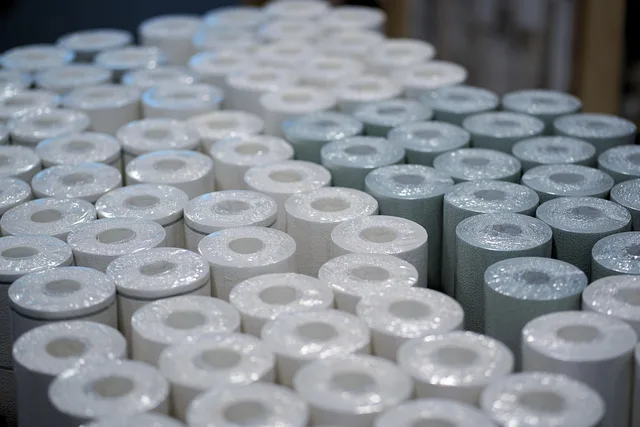
Paper is the largest and most awkward. It is bought by the parent sheet, delivered on pallets, and it changes character with humidity.
Three kinds of stock
| What the shop buys | Buying unit | What to record |
|---|---|---|
| Paper | Parent sheets, priced by weight or per thousand sheets | Grade, size, grain, mill lot, lead time |
| Ink and coating | By weight or by cartridge | Shelf life, storage duties |
| Plates and chemistry | Per job or per size | Usage per job |
| Digital press | Click charge under a contract | Monthly commitment |
| Packing, cores, pallets, blankets, cleaning materials, spare parts | Each item | Reorder point |
How a reorder point is set from your own records
For any item you intend to hold, the question is when to order, not how much to keep. Use named variables and fill them from your own records.
Reorder Point Arithmetic
- D: average usage per working day
- L: supplier lead time in working days
- V: variability between ordinary and bad week
- Lead-time demand = D x L
- Safety stock covers V
- Reorder point = lead-time demand + safety stock
The reorder point
- Dis average usage per working day, in the unit the item is bought in. For paper, that unit is parent sheets, not finished pieces.
- Lis the supplier's lead time in working days, measured from your order to stock on your floor. Use what actually happened, not what was quoted.
- Vis the variability you want to cover: the difference between an ordinary week and a bad one, expressed in the same unit.
- Lead-time demand is D multiplied by L. That is the quantity that will be consumed while a replenishment order is in transit.
- Safety stock is the cover for V over the same period, sized by how badly a stockout hurts rather than by a formula borrowed from a warehouse.
- The reorder point is lead-time demand plus safety stock. When the shelf reaches it, order, regardless of how the month feels.
Two adjustments matter in this trade. Lead times lengthen on specialty and non-house stocks, sometimes considerably, so L is per item rather than per supplier. And minimum order quantities can push the order size well above what the arithmetic asks for, which is a reason to keep the house stock list short.
Lead times decide almost everything
Lead time is the input that sets reorder points, and it is the one shops track least.
| Category | Typical behavior | What to record |
|---|---|---|
| House stock from a local distributor | 1 to 3 business days when it is genuinely in their warehouse | Actual days from order to floor, per item |
| Non-house commercial grades | 3 to 10 business days, longer in busy seasons | Days, plus how often the quoted date was missed |
| Specialty and mill-direct stock | 10 to 30 business days, with real minimum quantities | Days, minimum order, and whether a substitute exists |
| Ink and chemistry | 2 to 5 business days, occasionally longer | Days, and shelf life on what you hold |
| Plates and press consumables | 1 to 5 business days until a supply problem, then 10 to 15 | Days, and the reorder point that keeps a press running |
Record what actually happened rather than what was quoted. Lead times drift, and the first sign is usually a press waiting.
Why paper steps rather than slopes
The finished piece is not the unit you buy.
Finished Size Changes Sheet Yield
Current size
- Pieces per parent sheet
- Higher count
- Paper cost
- Lower per piece
- Waste
- Standard allowance
- Order quantity
- As planned
Slightly different size
- Pieces per parent sheet
- Drops by one
- Paper cost
- Steps up
- Waste
- Steps up
- Order quantity
- Steps up
How many finished pieces come off a parent sheet depends on the finished size, the bleed, the trim and the gripper allowance, and on grain direction where folding is involved. Change the finished size slightly and the count per sheet can drop by one.
Order quantity, paper cost and waste all move in a step at that moment, not gradually.
This has a practical use at the quote stage. A shop that can tell a customer their piece fits better at a slightly different size is giving genuine advice and saving real stock. It also means an inventory forecast built from finished-piece volumes is wrong in a way that grows with the mix. Build it from parent sheets.
Spoilage belongs in the same calculation. Makeready sheets, folder setup, a bad lift, or a bindery jam all arrive as paper and do not leave as product. Use the allowance your own reconciliation shows, not a figure that sounds reasonable. Revise it when the mix changes.
The trade-off: holding stock against stopping a press
Inventory ties up cash, takes space, and paper does not improve with age. Those are the real costs of holding.
Against them sits the cost of not holding: a press standing, a promised date missed, an expedited order at a worse price, or a job declined. In a shop where machine hours are the constraint, an idle press hour is more expensive than most owners assume, because it is capacity that cannot be recovered later.
The comparison is simple once both sides are written down. Hold depth on the few stocks that stop the press when they run out, and almost nothing on the rest. A second site or a shift extension changes both sides at once, which is part of the arithmetic in what a second location does to working capital.
What the presses consume, and how fast, comes from what each machine runs and at what rate; the surrounding kit assumptions are in the equipment list a new shop works from.
The question is never how much paper to keep. It is which items, when they run out, stop a machine that cannot be caught up later.
Storage that does not destroy the stock
Paper responds to its environment, and stock stored badly produces registration and folding faults that look like machine problems.
Storage that does not destroy
- Keep it flat, off the floor, wrapped until it is needed, and conditioned to the temperature of the room it will run in.
- Label lots with the date received and the mill lot where the supplier provides it, because color between lots is not identical and a reprint months later will show it.
- Rotate. Older stock first, always, and check for lots that have been sitting long enough to be a risk.
- Keep the stock room out of the traffic route. A pallet that has to be moved to reach something else gets damaged.
Mill lot and grain direction are not details. They decide whether a reprint matches and whether a fold cracks. Sheets made in different runs are not identical in shade or surface. Record the lot on the job ticket, tell the customer when a reprint will come from a different lot, and set the tolerance in your terms.
Check the tolerance against ISO 12647-2 for offset work or ANSI/CGATS.4 for measurement. Paper folds cleanly along the grain and cracks across it, particularly on heavier and coated stock. A house stock available in only one grain restricts what you can fold well.
Chemistry and ink storage carry duties, not preferences: safety data sheets must reach the people handling the material, and containers must be labeled to the current hazard communication standard. OSHA's printing industry pages are the starting point for what applies.
Quantities, cabinets and disposal routes are questions for your state environmental agency and local fire authority. Which body governs which question is mapped in who regulates which part of a print shop.
The reconciliation habit
None of the arithmetic above survives without one ordinary practice: count what came in and what went out, per job, and look at the gap.
Parent sheets issued against product delivered, with spoilage recorded by cause, correct both your waste allowance and reorder points. The IRS guidance on records to keep covers the form this ordinary business record needs.
Do it monthly at minimum. Shops that do it per job find the leak in weeks; shops that do it annually find it in the accounts.
Common questions
How many house stocks should a shop carry?
Few enough that every one of them is always in stock. A long house list is a stock room full of items with no depth, which is the worst of both outcomes.
Should I buy in bulk for the price break?
Only on house stocks you will certainly run, and only after checking that the storage is adequate and the cash is not needed elsewhere. A price break on a stock that sits for a year is not a saving.
What about stock left over from a customer's job?
Track it against that customer and tell them it exists. Unlabeled leftovers become general stock in practice and someone else's job in an argument.
How often should reorder points be recalculated?
When lead times change, when the job mix changes, or twice a year regardless. Supplier lead times drift quietly and nobody notices until a press is waiting.