Guides
California screen printing waste rules for Los Angeles print shops
California screen printing waste rules: how Los Angeles shops handle ink and solvent waste, air district permits, manifests, and CalRecycle duties.
What to take away
- California screen printing waste rules classify most ink and solvent waste as hazardous under state law, so it cannot go in the dumpster.
- CalRecycle regulates businesses that generate hazardous waste and publishes a list of materials banned from the trash, including printing chemicals.
- Los Angeles shops need a hazardous waste determination for every waste stream, proper labeling, and accumulation limits.
- The South Coast Air Quality Management District requires permits for solvent use and emissions, not just for large presses.
- Disposal must go through a registered hauler with a manifest, and shops keep those records for at least three years.
- Extended producer responsibility programs are pushing apparel printers to reduce waste at the source.
Which California waste rules catch screen-printing ink and solvent
Screen printing in Los Angeles generates waste that looks harmless but is regulated. Plastisol ink, UV ink, screen wash, and cleanup solvents all fall under California's hazardous waste rules when they exhibit a hazardous characteristic. The state adopts federal Resource Conservation and Recovery Act (RCRA) rules through the Department of Toxic Substances Control (DTSC), and local agencies enforce them.
If you run a shop in the city of Los Angeles, the LA County Fire Department's Health Hazardous Materials Division is your enforcing agency. In other parts of the county, it may be the county health department.
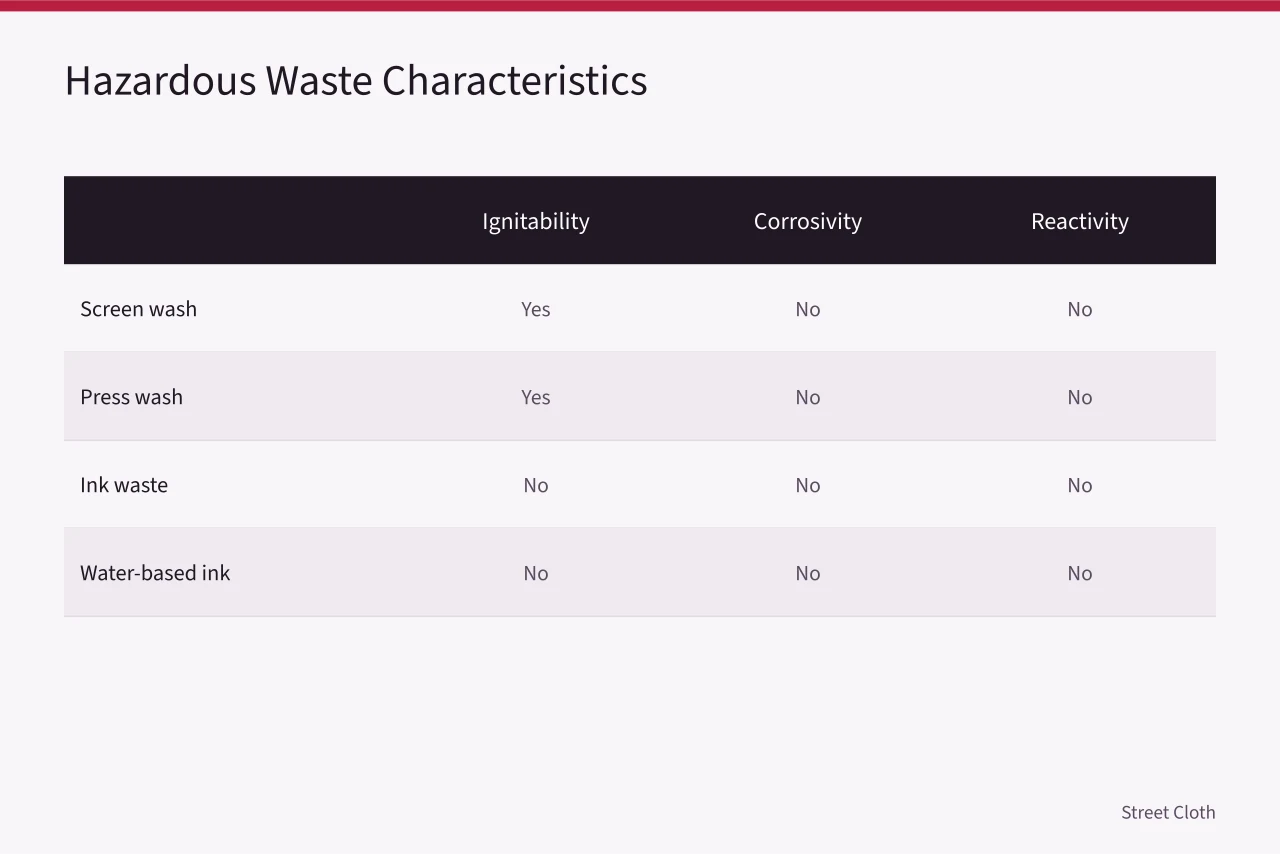
The first question is whether your waste is hazardous. Ignitability, corrosivity, reactivity, and toxicity are the four characteristics. Most screen wash and press wash contain solvents that flash below 140 degrees Fahrenheit, which makes them ignitable. That means they are hazardous waste.
Ink waste can also be toxic if it contains heavy metals like cadmium, chromium, or lead. Even water-based inks can fail a toxicity test because of pigments.
California also has its own rules that are stricter than federal law. The state bans certain wastes from landfills regardless of whether they are federally hazardous. For example, California bans liquid waste from landfills. That means a bucket of leftover ink or dirty solvent cannot go in the trash even if it is not technically hazardous.
This rule catches many small shops that think they are exempt because they generate little waste.
A common mistake is pouring solvent down the drain. That violates California's clean water rules and can trigger a sewer discharge permit requirement. The Los Angeles County Sanitation Districts prohibit discharging many printing chemicals to the sewer. If you have a floor drain in your screen room, you need to know where it leads.
Shops that print garments also deal with waste from emulsion, haze remover, and degreaser. These products often contain hazardous ingredients. The Safety Data Sheet (SDS) tells you the hazards, but it does not tell you if the waste is regulated. You need to make that determination yourself or hire a consultant.
The EPA's compliance resources explain the generator categories and what they require. You can start with the Compliance | US EPA page for a plain-language overview.
Generator categories turn on pounds per month. A very small quantity generator produces less than 220 pounds of hazardous waste a month, or less than 2.2 pounds of acutely hazardous waste.
A small quantity generator produces 220 to 2,200 pounds a month. A large quantity generator produces more than 2,200 pounds a month. California uses the same three tiers as the federal rule and layers its own accumulation limits on top.
California also regulates used oil and used oil filters separately. If you service your own press, you may generate used oil. That is a different waste stream with its own rules. Keep it separate from solvent waste.
CalRecycle regulated business duties and banned-from-trash materials
CalRecycle is the state agency that oversees waste reduction, recycling, and disposal. It runs the regulated business program that applies to many businesses, including print shops. If your shop generates hazardous waste, you are likely a regulated business. That means you must follow specific handling, storage, and disposal rules.
The Regulated Businesses - CalRecycle Home Page explains the requirements that apply to print shops and other businesses that handle hazardous materials.
One of CalRecycle's key roles is publishing the list of wastes banned from the trash. The Wastes Banned From the Trash - CalRecycle Home Page covers printing chemicals and other materials that cannot go in a dumpster. The list includes solvents, inks, and other printing-related wastes.
It also includes batteries, electronics, and fluorescent lamps. If you throw any of these in the trash, you are breaking the law.
CalRecycle also requires some businesses to implement a waste reduction plan. The specifics depend on the amount and type of waste you generate. In many cases, you must separate recyclables from trash and train employees on proper handling.
Your local city or county may have additional requirements. For example, the city of Los Angeles has its own recycling and waste ordinance that applies to businesses.
A common violation is putting empty ink containers in the trash. An empty container that held hazardous waste can sometimes be managed as non-hazardous if it meets the empty container rule. But that rule is strict.
You must remove all material by normal means, and the container must contain no more than one inch of residue. For a five-gallon bucket, that is a small amount. Many shops fail this test and accidentally dispose of hazardous waste in the trash.
CalRecycle also oversees extended producer responsibility (EPR) programs. These programs shift the cost of managing certain products from taxpayers to producers. The Product Stewardship and Extended Producer Responsibility (EPR) - CalRecycle Home Page explains how EPR works for different materials.
For apparel printers, EPR is starting to affect packaging and printed products. California's SB 54, the Plastic Pollution Prevention and Packaging Producer Responsibility Act, requires producers to reduce single-use plastic packaging. That includes plastic bags and shrink wrap used in garment printing.
If you print on apparel, you may also be subject to the state's textile recycling rules. California has been exploring EPR for textiles. That could mean new fees or reporting requirements for apparel producers. The direction is clear: producers will pay more for waste. Shops that reduce waste now will be ahead.
Hazardous waste determination, labeling and accumulation in a Los Angeles shop
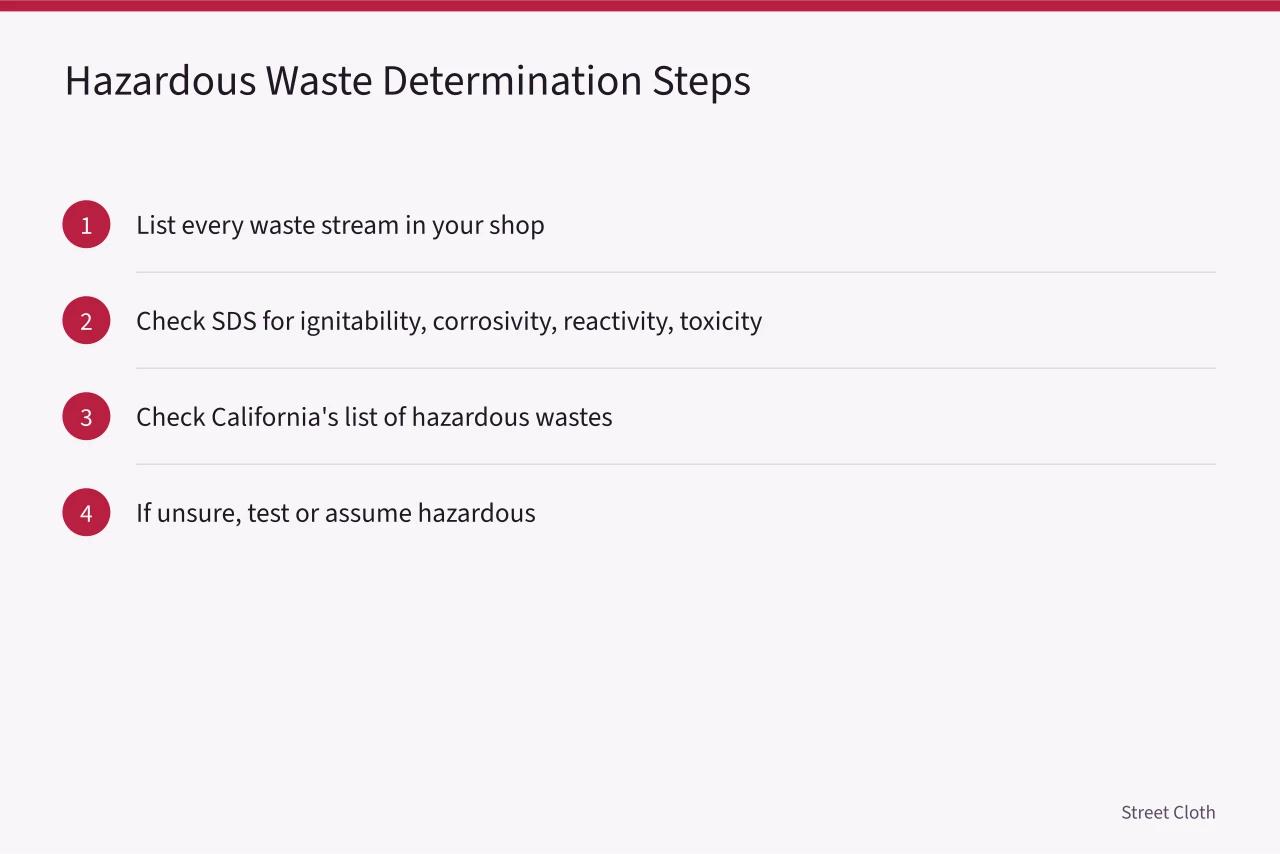
Every Los Angeles print shop must make a hazardous waste determination for each waste stream. That means you look at the waste and decide if it is hazardous. You can use your knowledge of the materials, or you can test it. The determination must be documented. If you say it is not hazardous, you need a reason.
The EPA's land, waste, and cleanup topics page provides background on waste identification and management. See Land, Waste, and Cleanup Topics | US EPA for the federal framework.
Labeling is critical. Every container of hazardous waste must be labeled with the words "Hazardous Waste," the contents, and the date you started accumulating it. You cannot leave containers unlabeled. Inspectors look for this first.
If you have a satellite accumulation area, you can accumulate up to 55 gallons of hazardous waste or one quart of acutely hazardous waste. Once you hit that limit, you have three days to move it to your main accumulation area.
In Los Angeles, the accumulation time limit for large quantity generators is 90 days. Small quantity generators can accumulate for 180 days. But many shops are very small quantity generators (VSQGs), which can accumulate up to 55 gallons of hazardous waste and 1 quart of acutely hazardous waste at a time.
VSQGs have no time limit on accumulation, but they must still dispose of waste properly. If you exceed the limit, you become a small quantity generator and face more rules.
A checklist for your shop:
- List every waste stream and its source.
- Check SDS and California lists for each stream.
- Keep containers closed except when adding waste.
- Inspect accumulation areas weekly for leaks and spills.
- Train employees on handling and emergency procedures.
- Keep records of waste determinations and disposal.
Accumulation areas must have secondary containment. That means a spill pallet or a curb. You also need a spill kit and a fire extinguisher. If you store waste outside, it must be covered to keep rain out. California's rainy season can fill open containers and create a spill.
Employee training is required for anyone who handles hazardous waste. They must know the hazards, the labeling system, and what to do in an emergency. The training must be documented. You can use the apparel screen-printing guide to identify which tasks create the most risk and focus training there.
The Los Angeles Fire Department may inspect your shop if you store hazardous materials. They look at quantities, storage, and fire safety. If you have a large amount of solvent, you may need a permit from the fire department. That is separate from environmental permits.
South Coast air district permits for solvents and emissions
The South Coast Air Quality Management District (SCAQMD) regulates air emissions in Los Angeles, Orange, Riverside, and San Bernardino counties. If your shop uses solvents or emits volatile organic compounds (VOCs), you may need a permit.
Many screen printers are surprised to learn that their small operation requires a permit. The rule applies to any equipment that emits VOCs, including screen cleaning stations and ink mixing areas.
SCAQMD has specific rules for solvent cleaning. Rule 1171 covers solvent cleaning operations. It sets limits on VOC content and requires specific work practices. For example, you must keep solvent containers closed when not in use. Rule 1171 caps the VOC content of most cleaning solvents at 25 grams per liter.
A few listed categories carry a higher limit, so check the rule table for the cleaning operation you run.
You must also keep records of solvent purchases and disposal. Rule 1171 applies to many screen printing shops, even small ones.
If you use a screen cleaning sink, it may need a permit. The sink must be designed to minimize emissions. You may need to install a lid or a control device. The permit process involves submitting an application and paying a fee.
Fees come from the district's fee schedule, which is updated every year. Typical costs for a small screen shop run from a few hundred dollars to file. Annual permit fees typically land between $300 and $2,000. The total depends on how many devices are permitted and how large they are.
Treat those as typical ranges and ask the district for current numbers.
The SCAQMD inspects permitted equipment regularly. If you operate without a permit, you can face penalties.
Ink and solvent disposal is tied to air rules because VOCs evaporate. If you leave solvent rags open, they emit VOCs. That can contribute to your shop's overall emissions. The South Coast air district permit may include conditions on how you store and handle rags. You may need to keep them in a closed container.
Some shops use water-based inks to avoid VOC rules. Water-based inks have lower VOC content, but they still contain some solvents. The SCAQMD may still require a permit if you use certain additives or cleaning agents. Check with the district before you assume you are exempt.
If you are in Los Angeles County, you may also be subject to Rule 1130, which covers graphic arts operations. This rule applies to printing presses, including screen printing. It sets VOC limits for inks, coatings, and cleaning solvents.
The limit that applies to you depends on the ink system and the substrate, because the rule lists a separate number for each category. A shop that cannot meet the content limit must capture and control the emissions instead. It also requires recordkeeping. You must keep monthly records of VOC content and usage. That helps the district track emissions.
Permits are not just paperwork. They come with conditions you must follow. For example, you may need to keep a log of solvent usage. You may need to perform monthly inspections. If you violate a permit condition, you can be fined. The fines can be thousands of dollars per day.
To apply for a permit, contact SCAQMD. They will tell you which forms you need. You may need to provide a process description and material safety data sheets. The process can take several weeks. Do not wait until you receive a notice of violation to apply.
Manifesting, disposal vendors and documentation Los Angeles shops keep
When you ship hazardous waste off-site, you must use a hazardous waste manifest. The manifest is a tracking document that follows the waste from your shop to the disposal facility. It lists the waste type, quantity, and destination. You, the transporter, and the disposal facility each keep a copy.
The manifest protects you if the waste is misdirected. Without a manifest, you cannot prove proper disposal.
In California, you must use the state manifest form. The state uses a manifest tracking system. You need an EPA ID number to ship hazardous waste. If you do not have one, you can get one from DTSC.
The EPA ID number is required on the manifest. If you generate hazardous waste, you must have an EPA ID number, even if you are a VSQG.
The manifest has multiple copies. You keep one, the transporter keeps one, and the disposal facility keeps one. The facility sends a copy back to you after it receives the waste. That is your proof of delivery. If you do not receive the signed copy within 45 days, you must investigate. You may need to file an exception report.
Choosing a disposal vendor is important. You should use a registered hazardous waste transporter. The transporter must have a valid registration with the California Highway Patrol. You can verify their registration online. The disposal facility must have a permit to accept your waste. You can check with DTSC or the EPA.
When you hire a vendor, ask for their EPA ID number and permits. Get a written contract that specifies the waste streams they will accept. Do not assume they will take everything. Some vendors do not accept certain inks or solvents. You may need to separate waste streams.
The manifest and disposal records are part of your documentation. You must keep them for at least three years. Some shops keep them longer. During an inspection, you will need to show that you properly determined, labeled, and disposed of your waste. If you cannot produce manifests, you may be cited.
A manifest record includes:
- The manifest form with all signatures.
- The waste profile sheet for each waste stream.
- The land disposal restriction notification.
- The certificate of disposal from the facility.
- The transporter's registration.
- The facility's permit.
You should also keep records of your hazardous waste determination. That includes your reasoning and any test results. If you use a consultant, keep their report. If you test waste yourself, keep the lab results.
Disposal costs vary. You pay per drum or per pound.
Typical figures run from about $300 to $1,000 per 55-gallon drum of solvent waste. Vendors that bill by weight often quote roughly $1 to $3 per pound for solvent-bearing waste, plus a minimum pickup charge.
Ink sludge, oily water and lab-packed debris price differently. Treat those as typical ranges and get a written quote for each waste stream. Solvent waste is often more expensive than ink waste.
You can reduce costs by segregating waste and recycling solvents. Some vendors offer solvent recycling services. That can reduce the amount you ship off-site.
If you are a VSQG, you may be able to dispose of your waste at a local household hazardous waste facility. But not all facilities accept business waste. You need to check with the county. In Los Angeles, the county operates several hazardous waste collection events for businesses. You must register in advance.
Where to go for each item:
Manifesting, disposal vendors and documentation
- EPA ID numberDTSC issues California EPA ID numbers. File the Notification of Regulated Waste Activity with DTSC, or ask your local Certified Unified Program Agency for the form.
- Business waste eventsLos Angeles County Public Works runs the household hazardous waste and e-waste collection events. Some locations accept small business waste by appointment. Check the county's hazardous waste page for dates and limits.
- Air district permitsSCAQMD's Small Business Assistance Office answers rule and permit questions from small shops and helps with the application.
Waste reduction, reclamation and extended producer responsibility pressure
Waste reduction is the best way to cut disposal costs and regulatory burden. The first step is to use less material. For screen printing, that means optimizing your ink usage.
You can use a scoop coater to apply emulsion evenly. You can reclaim screens instead of buying new ones. You can switch to water-based inks that require less solvent for cleanup.
Reclamation is the next step. You can reclaim screen mesh and frames. You can recycle solvent by using a solvent recycler. That distills dirty solvent back to clean solvent. The still bottom is hazardous waste, but it is a smaller volume. You can also recycle ink containers if they are empty.
Extended producer responsibility (EPR) is a policy approach that makes producers responsible for the end-of-life of their products. In California, EPR programs exist for paint, mattresses, and pharmaceuticals. For apparel, EPR is on the horizon. The state has been studying textile waste.
California has moved past the study stage. SB 707, the Responsible Textile Recovery Act of 2024, directs CalRecycle to set up a producer-run collection and recycling program for apparel and other textiles. CalRecycle has until 2028 to adopt the rules, and collection is expected to begin by 2030.
The producer is the brand owner or the importer who first puts the article on the market. A contract printer working for another company's brand is usually not the producer. A shop that sells its own branded garments, or imports blanks and resells them under its own label, can fall into that definition.
Packaging is already covered. SB 54, the plastic packaging law, sets three targets for covered single-use packaging by 2032. All of it must be recyclable or compostable. Single-use plastic packaging must shrink 25 percent at the source. The recycling rate must reach 65 percent.
Print shops sit inside that system as buyers of shrink wrap, poly bags, and tape. Your suppliers will pass those costs down.
CalRecycle's EPR page explains the concept and current programs. The pressure is growing. Brands are already asking printers for sustainable practices. Some brands require printers to have a waste reduction plan. If you want to keep those clients, you need to show you are reducing waste.
There are practical steps you can take now. Conduct a waste audit. Weigh or count your waste streams for a week. Identify the biggest sources. Then set reduction targets. Train employees on waste sorting. Put labeled bins for recyclables, hazardous waste, and trash. Make it easy to do the right thing.
You can also work with your suppliers. Ask for inks with lower VOC content. Ask for containers that can be recycled or returned. Some suppliers offer take-back programs for empty containers. That can reduce your hazardous waste stream.
Finally, document your efforts. Keep records of waste reduction, recycling, and training. That documentation can help if you are inspected. It also shows customers and regulators that you are serious about compliance.
For more on safety and waste in apparel printing, see the guide to apparel production roles compared. It covers the broader safety picture. You can also review the apparel blank guide checklist for a practical walkthrough.
And if you are dealing with screen-printing registration drift, that article addresses common shop problems. For a comparison of control methods, see digital apparel printing guide.